AI Can Write Code. You Still Need to Think.
Why understanding data matters more than ever
Recently, NVIDIA’s CEO Jensen Huang made a striking statement:
“The new programming language is English.”
The idea is simple. With AI tools, many people no longer need to write every line of code. They describe what they want, and the system produces the implementation.
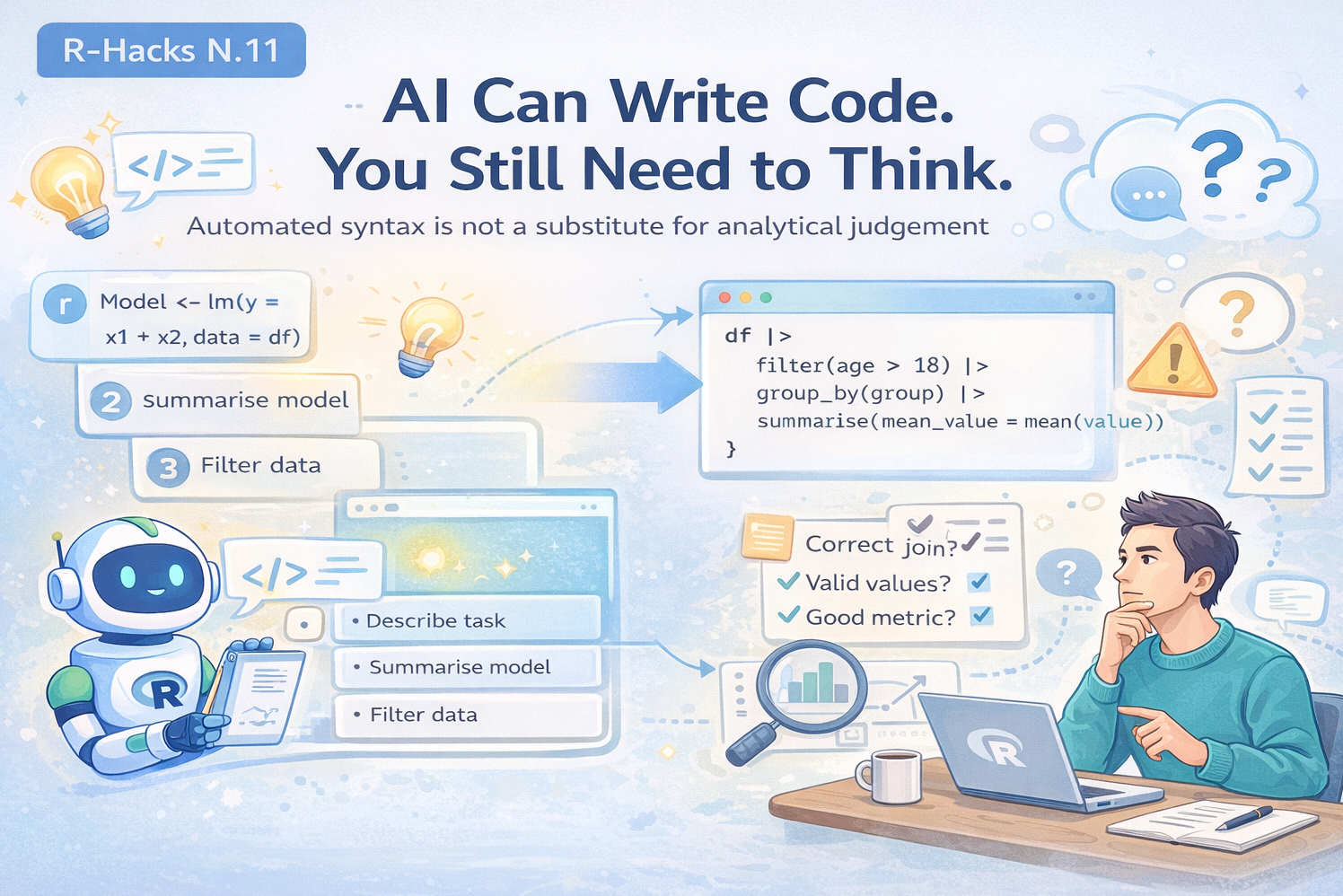
This changes how we write code. It does not change the need to understand data.
The real shift is not from R to Python, or from coding to prompting — it is from syntax skills to analytical judgement.
1️⃣ What AI Actually Changes
AI reduces the friction of writing code.
Instead of:
model <- lm(y ~ x1 + x2, data = df)
summary(model)
You can now describe:
“Fit a linear model with these variables and summarise it”
And obtain a working result.
This is powerful. It lowers the barrier to entry and speeds up experimentation.
But something important remains unchanged: AI produces code, it does not validate reasoning.
2️⃣ What AI Does Not Automatically Do
AI does not naturally question:
- whether your variables are appropriate
- whether your data contains errors
- whether joins were correct
- whether filtering removed critical observations
- whether assumptions are valid
For example:
df |> filter(age > 18)
|> group_by(group)
|> summarise(mean_value = mean(value))
This may run perfectly.
But AI will not automatically ask:
- Should age be filtered this way?
- Are missing values handled?
- Are groups balanced?
- Is the mean the right metric?
These are analytical decisions.
3️⃣ The Skills That Become More Important
If AI makes syntax easier, other skills become more valuable.
Not:
- memorising functions
- writing boilerplate code
But:
- asking better questions
- checking assumptions
- validating data structure
- interpreting results
- explaining findings clearly
In other words:
AI reduces the cost of coding.
It increases the value of thinking.
This is why small habits — like the ones in the R-Hacks series — matter more, not less.
4️⃣ Where R Still Fits
R remains particularly strong as a thinking environment.
Not just because of syntax, but because of workflow design:
- fast exploration
- transparent modeling
- reproducible reports
- readable transformations
- strong statistical foundations
R encourages analysts to:
- inspect
- question
- iterate
- document
These are reasoning activities, not just coding tasks.
The Practical Conclusion
AI is changing how we write code.
But it is not replacing:
- understanding data
- analytical judgement
- statistical reasoning
- careful validation
Those skills are becoming more important, not less.
In Short
- AI makes coding easier
- AI does not replace analytical thinking
- Understanding data remains essential
- Good workflows matter more than syntax
- Tools change. Reasoning remains.
Programming may become easier to start.
But good analysis will always depend on understanding what the code is actually doing.
If you want to stay up to date with the latest events and posts from the Rome R Users Group:
👉 https://www.meetup.com/rome-r-users-group/